


























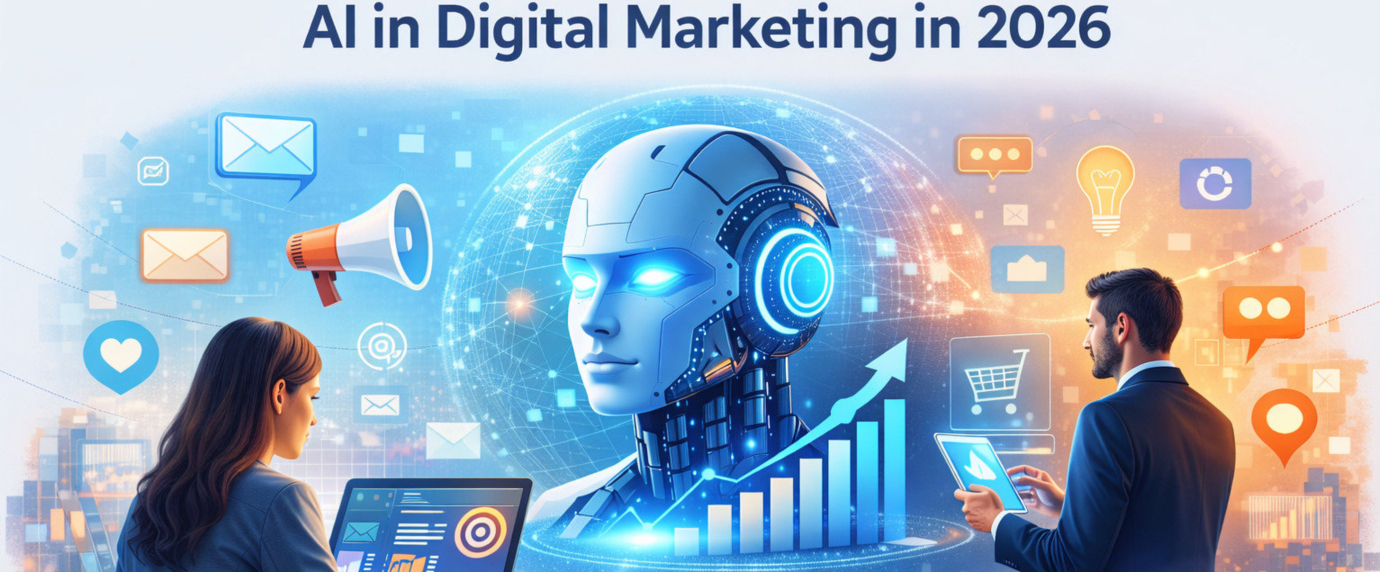
Digital marketing has evolved more in the past few years than it had in the previous decade. Artificial Intelligence (AI) has ceased to be a choice in 2026. It is now the daily weapon of every marketer in town. AI is now a critical part of virtually every marketing activity, from campaign planning to customer understanding.
This transformation isn’t about machines replacing humans. Instead, AI assists marketers in smarter work that is faster and delivering better results. Companies that grasp and deploy AI properly are building powerful advantages, while lagging rivals are waning.
In this short article, I tell you plainly what AI is doing to the digital marketing landscape in 2026 and why it is important for businesses, marketers and customers.
In 2026, AI is transforming digital marketing and improving sectors like tractor technology through smarter automation.
Understanding AI in Digital Marketing
AI in digital marketing requires the use of smart systems which can learn, process data and then make productive decisions with little or no human intervention. These systems analyze users’ activities and behaviors, trends and performance in real-time to boost marketing results.
In 2026, AI tools have become the staple not only of big companies but are also widely used by small businesses. Nowadays many platforms have AI features built into them, enabling all sorts of advanced marketing to be available for everyone.
AI helps marketers:
- Understand customers better
- Personalize content
- Automate repetitive tasks
- Improve ad performance
- Predict future trends
AI and Customer Behavior Analysis
One of the largest advantages of AI is how in tune it is with customers. Marketers used to depend on surveys and crude analytics. Today, A.I. analyzes real-time data from that costs on web sites like websites, apps, email and social media.
AI tracks:
- Pages users visit
- Time spent on content
- Purchase behavior
- Search patterns
- Engagement levels
Based on this data, AI creates robust customer profiles. These profiles can help marketers learn to understand what customers desire, at what point in the journey they desire it and how they want to interact. This results in more precise targeting and more informed marketing decisions.
Hyper-Personalization in 2026
And now, in 2026, personalization has entered uncharted territory. AI enables marketers to craft personalized experiences for every individual. This is known as hyper-personalization.
Examples include:
- Bespoke website content for every user
- Personalized product recommendations
- Customized email messages
- Real-time behavior based ads displayed
AI is able to analyze user actions in real time and tweak content on the fly. This helps customers feel like they’re being heard and appreciated, which ultimately leads to trust and loyalty.
Hyper-personalization also increases user engagement by having the right content in front of people that actually want to see it.
AI-Powered Content Creation
Content continues to be at the core of digital marketing, and there’s no doubt that AI has revolutionized how content is generated. By 2026, marketers have assistive tools that leverage AI to research, ideate and optimize.
AI can:
- Suggest blog topics
- Improve headlines
- Check readability
- Optimize keywords naturally
- Analyze content performance. Yet human input is still vital. Marketers adopt AI as an assistant, not a substitute. The best content in 2026 represents the combination of AI efficiency and human creative brainpower and emotion. This sweet spot enables brands to produce content more quickly with compromising authenticity.
Voice Search and Conversational Marketing
Voice search is really popular in 2026. People are now hunting through voice assistants on their phones, smart speakers and in their cars. AI powers the ability of marketers to interpret such voice-based searches.
Voice searches are usually:
- Longer
- More conversational
- Question-based
A.I. can put advertising in front of people who don’t realize they want something yet by analyzing speech patterns and helping marketers optimize content to match it. This increases the visibility when in voice search.
Meanwhile, chatbots have been getting smarter thanks to AI. They answer questions from customers, book appointments, recommend products and even handle complaints. They can give an immediate answer, so that customers are satisfied.
AI in Social Media Marketing
2026 The first thing you realise is that social media networks are now completely reliant on AI;.” AI decides what people see, when they see it and how often.
For marketers, AI helps:
- Identify trending topics
- Choose the best posting time
- Analyze audience engagement
- Improve content strategy
AI tools also assist in tracking brand mentions and customer sentiment. This means companies can more accurately respond to feedback and better manage their online reputation.
AI has made social media marketing more data-centric and less guess-oriented.
Smarter Paid Advertising with AI
All paid advertising has been transformed by AI. By 2026, AI runs nearly all components of ad campaigns on autopilot.
AI helps with:
- Audience targeting
- Budget allocation
- Creative testing
- Performance optimization
Ads are tweaked constantly according to performance. If one ad proves to be more effective, the budget automatically shifts there thanks to AI. This decreases waste and increases ROI.
Today, marketers increasingly need to be concerned with strategy and messaging while letting AI do the executing.
Predictive Analytics and Future Planning
One of the most potent applications of AI is predictive analytics. Marketers can use it to anticipate future behavior based on previous data.
AI can predict:
- Which consumers are most likely to purchase
- Which products may trend
- Which campaigns may perform well
- When customers may leave
These findings can inform companies’ marketing plans. Now, rather than being reactive, marketers can be proactive. “The use of predictive analytics is now a basics part of making smart decisions, and the year: 2026”
AI in Email Marketing
Email marketing works better in 2026 thanks to AI. It uses AI to analyze how users behave so it can send emails at the best time and with the content that is most likely to resonate.
AI improves:
- Subject lines
- Email timing
- Content personalization
- Audience segmentation
This increases open rates and improved engagement. AI also helps lower spam complaints by increasing relevance and quality.
Email is still a powerful conversion driving channel, underpinned with smart automation.
AI and SEO in 2026
SEO has advanced as well. AI support in helping to understand search intent and how to tailor content accordingly for marketers.
AI supports SEO by:
- Analyzing search trends
- Identifying content gaps
- Improving on-page optimization
- Tracking ranking changes
Search engines themselves employ AI to rank content. This, in turn, means quality, relevance and user experience matter more than ever. Now, marketers concentrate on useful, accessible content over keywords stuffed into high wild stars.
Ethical AI and Data Privacy
Data privacy has emerged as a major concern in the age of growing A.I. use. In 2026 consumers are increasingly conscious about how their data is utilized.
Businesses are expected to:
- Be transparent about data usage
- Follow privacy laws
- Use data responsibly
Ethical AI reflects well on your brand and builds trust. Businesses that abuse data can lose the trust of consumers.
Responsible AI use is now a solid element of digital marketing strategy.
Challenges of AI in Digital Marketing
While there are a number of upsides, AI also presents new challenges.
Common challenges include:
- High dependency on data quality
- Some without human judgment
- Privacy concerns
- Skill gaps in teams
To address these challenges, companies should receive adequate training, establish clear guidelines and take a risk-based approach to use AI in concert with human intervention.
The Future of Digital Marketing with AI
AI is only going to improve, but human creativity will always be necessary. The key for the future of digital marketing is to get machines and humans working together.
In 2026, successful marketers:
- Use AI to support decisions
- Focus on meaningful customer experiences
- Stay updated with new tools
- Follow ethical practices
AI isn’t coming — it’s in the hierarchy now.
AI in Influencer Marketing in 2026
Artificial intelligence has done a lot to revolutionize influencer marketing. In 2026, brands don’t work with influencers based solely on their follower count. AI-powered tools dive into deep data in the search for the right creator for every campaign.
AI now helps brands analyze:
- Audience quality
- Engagement authenticity
- Past campaign performance
- Audience interests and behavior
- Fake follower patterns
This enables companies to keep from throwing good money after influencers who don’t actually deliver results. Instead, they can collaborate with creators who actually sway buying decisions.
AI also helps pair influencers with brands that align on values, tone and audience type. This fosters more organic partnerships the viewer can feel genuine about.
AI-Driven Video Marketing Growth
In 2026, video has emerged as one of the most powerful marketing formats. AI has a large part in making video marketing ever more convenient and effective.
AI tools help marketers:
- Choose the best video length
- Decide ideal posting times
- Generate captions and subtitles
- Improve video thumbnails
- Analyze viewer drop-off points
AI is also used to repurpose one video in many formats. An elaborate video can be automatically sliced into short clips, reels or stories. This is a time-saver, as well as ensuring continuity of content across the platforms. With video continuing to expand, AI allows for better planning, better reach and ultimately better engagement.
AI and Customer Journey Mapping
AI Makes It Easier to Understand the Customer Journey. AI watches how users circle from platform to platform before making a choice in 2026.
AI studies:
- First interaction point
- Content consumed before purchase
- Time taken to convert
- Drop-off stages
- Repeat visits
Based on this insight, marketers can enhance the weaker points of the journey. For instance, if a large number of users abandon the site after checking out the pricing page, A.I. could recommend changes.
This results in seamless passengers experience and maximized conversions.
AI in Customer Retention and Loyalty Programs
Acquiring new customers is expensive, so retention is critical. AI is used to keep up engagement of current customers.
AI supports retention by:
- Identifying unhappy customers early
- Sending personalized offers
- Suggesting loyalty rewards
- Predicting churn risks
Based on real behavior not rules An AI loyalty program teaches your program what makes users happy and rewards them accordingly. This helps rewards to feel more immediately relevant and valuable to customers.
Satisfied customers stick with brands longer and endorse them to their peers.
AI-Powered Website Experience Optimization
What are websites like in 2026?>”) Websites in 2026 look so much smarter thanks to AI. AI enhances user experience by making website’s elements responsive on their own.
AI can change:
- Homepage layout
- Call-to-action buttons
- Content order
- Product displays
- Page load suggestions
Each visitor might experience a different rendition of the website genesised on their actions. This makes it easy for users to find what they are looking for quicker, lowering the bounce rate.
A better web experience means more trust and ultimately higher sales.
AI and Marketing Automation at Scale
Marketing Automation for 2026 Now that takes marketing automation to a level beyond. Artificial intelligence operates across complex workflows on multiple channels simultaneously.
AI automates:
- Lead nurturing
- Follow-up messages
- Campaign scheduling
- Customer segmentation
- Performance tracking
This gives marketers the ability to work with huge audiences without sacrificing personalization. Large campaigns can run like clockwork, even with a small team. Highly automated tasks should result in less time spent, better accuracy and more consistency.
AI in E-commerce Marketing
E-commerce profit hugely from AI in 2026. AI enhances both marketing and shopping experiences.
AI helps with:
- Smart product recommendations
- Dynamic pricing
- Cart abandonment recovery
- Personalized shopping journeys
- Demand forecasting
AI can recommend products based on browsing, past purchases and other user patterns. This leads to higher average order value and happier customers. Online brands using AI have higher sales and better customer loyalty.
AI and Real-Time Marketing Decisions
And in 2026, speed is more important than ever. AI enables marketers to take real-time decisions.
AI can:
- Pause poor-performing campaigns instantly
- Boost high-performing content
- Adjust messaging based on trends
- Respond to customer behavior immediately
This flexibility allows brands to remain relevant for fast-changing situations (festivals, trending topics or an abrupt change in market).
Bandying those decisions in real time provides brands with a competitive advantage.
AI in Market Research and Competitor Analysis
It used to take weeks or months of traditional market research. Six years later, in 2026, AI brings us fast insights. AI tools analyze:
- Market trends
- Competitor strategies
- Customer feedback
- Social conversations
- Industry movements
This allows companies to be ahead of the competition. They can recalibrate tactics rather than be forced to react after the fact.
It brings together faster, cheaper and more accurate research on A.I.
AI Skill Requirements for Marketers in 2026
With AI ubiquitous, marketers need new skills. Power users are good, but those who know how to use AI tools are better.
Key skills include:
- Data interpretation
- Tool selection
- Strategy planning
- Ethical decision-making
- Creative thinking
Marketers who pick up on how to work with AI will climb the career ladder faster. The stubborn may have a hard time.
Learning and adaptation are key.
AI Budget Planning and Cost Optimization
AI can also help better manage marketing budgets. In 2026, artificial intelligence has taken over financial management, and in analyzing spending trends it begins to cut corners on waste.
AI identifies:
- Channels with low returns
- Campaigns needing improvement
- Budget reallocation opportunities
- Cost-saving strategies
This way, the spending goes where it has the most beneficial effect. Better budget planning improves profitability.
AI and Multilingual Marketing Expansion
AI has simplified international marketing. Artificial-intelligence-driven translation and localization tools enable brands to speak easily across geographies.
AI adapts:
- Language
- Tone
- Cultural context
- Visual preferences
This enables brands to effectively penetrate new markets without employing heavy local headcount. Global expansion is faster and cheaper.
AI and Emotional Analysis in Marketing
By 2026, AI may even read emotions. More sophisticated AI tools analyze tone, words and behavior to ascertain how users are feeling.
AI detects:
- Satisfaction levels
- Frustration
- Interest
- Intent to buy
This enables marketers to adapt the messaging for a match with customer emotions. There is engaging and trust-building emotional resonance.
Final Thoughts on AI Growth
AI is not slowing down. It’s position in the digital marketing and advertising world only looks to grow further beyond 2026. Businesses that make the investment in learning, ethics and smart implementation will gain the most.
AI will succeed not on tools alone, but on how well humans lead them.
Conclusion
AI is changing digital marketing in 2026 by turning it into an intelligent, personalized process that gets results. AI enables marketers do more with less; from finding customers you can target to finally seeing how everything is performing.
Businesses that adopt AI in a mindful way will continue to remain competitive and establish better relationships with their audiences. Those who pay it no heed risk being unable to keep up in the rapidly evolving digital universe.
The secret is to utilize the AI as a partner, not a substitution, and keep that human element alive.